You are hereMCN in chicago: directors and it professionals
MCN in chicago: directors and it professionals
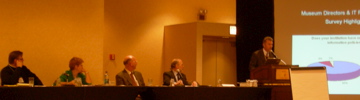
Nik Honeysett moderates a panel of two directors who share the podium with their heads of IT staff.
James Cuno, Director of the Art Institute of Chicago, is a techno-convert, realising that his daughters live in a world where information is on-line, people have ipods and the museum is featured on YouTube in visitor-created videos. Committed resources, time and staff, to make this happen.
Janice Klein, Director of the Mitchell Museum of the American Museum, is in a small museum, without IT staff, struggling to manage technology with volunteers and limited expertise. Challenge of maintaining infrastructure is significant; her colleagues are focused on outcomes and technology is a tool. Drivers are often the members of the Board.
Sam Quigley has a privledged position as an IT person at the table with museum senior management (thought his isn't as rare as it once was).
John Dodge works on 'soft money', responding to immediate needs.
Nik: how do we develop the understanding of technology at a strategic level?
Jim: baffled that the understanding is missing, but feels that there needs to be a champion who has some influence with the director (either staff or trustee). at the board level there is a lot of leverage. the fear of failure is real, and "the museum will succeed only to the extent that it rides with this wave of technological development". resources may always be a problem but it's impossible to ignore. strategy is required throughout the museum, not just in technology, so we need to think about tech with a long horizon.
Janice: museum can be boring places for IT. there is a tension between wanting to have tech and not wanting to develop it. many museums can't do R&D. Jim is unusual in his appreciation of the tech available. often what gets done is a compromise between different areas of responsibilities, and IT staff need to understand that this is happening.
Nik: IT goes to Director with a plan and gets an OK but for half the money and half the time. what's going on here? is it a ritual dance? where's the trust?
John: large projects often mean infrastructure changes that are outside the frame of the project per se.
Sam: trust is important, so we eed to make lean budgets and stand your ground. finding ways to raise money is a key part of the plan.
Janice: in a small museum, it's important to find multiple uses for a single action. need to leverage investments to have broader impact and effect.
Nik: does trust come from not admitting what we don't know
Nik: how do we get your colleagues to think like you?
Jim: being alive and dynamic, and in the world attracts attention and funding. it's part of our trust to be out there in the world. we need to do it to be relevant and engaged.
Rich Cherry: it's not about fixing the person upstairs! My job as a tech professional is to see if from their perspective. it's not about the tech, its about the issues in the organization. so think like your director-- what's important to him. if your project serves the mission well, it's going to be well received. if your project saves money - and it can be demonstrated -- then your message will be received. But if your project is inherently interesting but can't be tied to your institution then it isn't critical, and may not be well received. We need to be part of the business.
Len: how do we measure the contribution of tech projects? first of all, it's not about technology projects ... it's about projects that serve the institution, and we need to talk that way. ROI can be measured in three ways:
- cash based: investment vs payback over X term {includes opportunity cost - enabling]
- mission based: helps us meet goals of the institution [relate to expressed needs]
- social rate of return: community impact and effects [hard to measure but important when deaing with community projects]
jt: so speak english, and talk about why, not how. this reminds me of the workshop we did at MCN some time ago ...
NIk's summary: technology people have been comparmentalized. were we always?
Comments from the floor: need to talk english, need to demonstrate relevance, understanding of mission
Janice: a basic conflict exists, because many people in museums see the value in museums in 'the real thing' and that this needs to be addressed through projects that enhance experiences with the real thing. her background in collections care has echoes
jt: trust doesn't come overnight -- it's incremental and it's built gradually. it comes from having knowledge and sharing it. it comes from being open and incorporating other people's needs into your plans. it comes from small projects that are successful, and learned from. and projects that aren't successful, honestly acknowledged and learned from. but there are some echoes from this morning: if we don't know what we're doing ourselves as a community then how can we share the knowledge that we have? if we don't share information amongst ourselves, then we can't cite it to others.
Julie: Field Museum: listening is critical, fundraising is now a part of any vendor discussion; the traditional museum it professional doesn't have a tech background (environment and salary are too different) but there are creative ways to staff (including proportional positions) to bring on expertise.
Sam Quigley: need to realise that directors hear many voices, and our message needs to come from many places.
Matt Morgan: how many people have management training? because much management is managing up ... need to understand not just how to manage our staff but how to manage our superiors.
Len: change management, managing disemmination and managing opinion are possible topics for future sessions
generational change coming, but change can be facilitated without
rich: if you can't make stuff work every day then you can't try anything else. if word doesn't work, if email doesn't work then you can't do anything funky. so investiment in IT is investment in infrastrucute (if the roof leaks ...) when you give people better tools then you can do more and more work. show people how it works, start small, be open, listen. figure out what they need to do, and then help them do it better. it's not what's good for you, it's what is good for them...
Nancy Allen: writing about it is important; they need words that they can look at to think about. briefings are critical.
closing: Robert L. Dilenschneider: "paradigm shifing ... technology as a teaching tool"... "accept, adapt and accellerate ... or simply atrophy"
L.A. Art OnLine publication from the Getty Foundation: Learning from the Getty's electronic cataloguing initiative: MCN members will be getting copies.
Nik is also going to blog the session on Musematic.
... on the Musematic blog at http://musematic.net/?p=279
Holly deserves lots credit for these, too!
/jt
j. trant co-founder Museums and the Web | partner archives & museum informatics www.archimuse.com