You are hereat MCN in Chicago: past presidents' panel
at MCN in Chicago: past presidents' panel
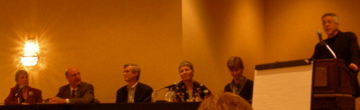
Jim Michalko introduced a panel of MCN's Past Presidents: Diane Zorich, Susan Patterson, Chuck Patch, Sam Quigley, Marla Misunas
The panel reflected on the history of MCN, and the challenges that they faced during their tenure, adminstrative, or mission-based. They reflected on challenges such as internationalization, collaboration across the discipline and beyond it, standards deveopment (particularly with CIMI), communications (spectra, web site development, board and governance).
Jim asked the panel to reflect on the issues that the profession has faced, and our achievements in past few years.
Quigley: professional development is a critical issue for us all. we need to find a way to go for it, and define the question of competencies, to help people with training.
Zorich: AAM and MCN need to refine their relationship, to raise the voice for technology at the leadership level.
Misunas: noted that Holley Witchey has helped play this role, particularly when MCN has exhibited at AAM. [Holly mentioned a Musematic post -- but a quick google doesn't find it, help? Thanks to Richard, see below, here's the link: http://musematic.net/?p=46))
Jim: How do you have impact?
Quigley: continuity and organizational stability is important. Under Marla's presidency, MCN has developed a strategic plan (with Zorich as consultant).
Patterson: it's important to maintain the enthusiasm past the conference; as a membership organization the grassroots contribution is important.
Patch: Bringing technology into the entire institutional perspective has been a long-term issue for MCN; this seems to be changing, as we work with organizations like AAMD (the Association of Art Museum Directors).
Jim: internal focus isn't always effective (changing names, changing management structures, changing membership structures can take up a lot of energy but not really contribute much). But how does competition between museums affect the job that you do? does it enable or provide opportunities?
Misunas: competition between board members put things on the table; competition around events (like anniveraries) enable new programs.
Patch: there is a danger that the glitz takes away from organizational fundamentals - structural issues within organization
Patterson: yes, there's a question of relating organizational structures and technological infrastructures and strategies.
Jim: one of the challenges shared by archives, libraries and museums is a lack of process standardization; it's hard to have a broad transformative impact. How do structural forms of IT management contribute to the impact that tech can have in the organization?
Quigley: (on the last question) competition is a good thing for enabling activities that we want to do (like on-line collections access). Tech can provide an impact; web does provide some power in visibility. Directors can provide motivations.
Jim: what kinds of things would you do to capitalize on these opportunities?
Misunas: technology plans might help (but she isn't sure that they have one)
Quigley: budgetary expressions of benefit could help? removal of redundancy, sharing of information ...
Jim: are there natural allies within the institution to begin to have the conversation about the benefits?
Patch: In a small institution re-engineering is a problem; the organization hasn't adapted in the ways that it might have.
Jim: is this an opportunity to look hard at why we can't re-direct resources?
Patterson: threatening to exisiting organization to think in new ways.
Quigley: but it is possible to have allies, and to work with them towards change (like helping curators think through the benefits of social tagging)
Misunas: at SFMOMA the director of IT is on Senior Staff and that is very important to be sure that technology becomes an issue throughout the museum. this has provided a way to introduce ideas to the museum as a whole (like tagging).
Patch: sometimes its hard to introduce new ideas to tech staff, not even outside tech dept.
Jim: Are people making connections between discoverability and what people can do with collections? acknowledging that this is what it is for?
Patterson: often not
Zorich: people are doing this for museums, even if we don't do it ourselves. seeing what people are doing with museum data is a good point of deparature
Jim: how do you help people see the potential?
Quigley: curator herself went out and looked at 'egg and dart' as a search term in flickr; this helped her see differently. there are ways that people can be brought along. there is a fear that doing something new takes away from something that you are doing already.
Jim: comparison with the academic library community is interesting. the brick and mortar role of the library is diminishing (students aren't going to the library and aren't checking out books). in the museum community there is still a strong need to bring people in. is this inhibiting technology?
Misunas: these are two different things that don't inhibit each other. counting is different in the two environments (never really know what people are doing on the web site beyond that they came, and how long they stayed).
Zorich: two different worlds that do diferent things in the same ways.
Patch: exhibits are fast moving vehicles on which to jump to get things done. they are an opportunity to do some other things that wouldn't happen otherwise. e.g. get detailed cataloguing when something is exhibited.
Bearman: a past president became involved with MCN when he represented the Smithsonian when MCN was an institutional membership organization (because insittuitons had organizations). when mcn became a membership organization one of its first pre-occupations was comparing commercial software. So there were sessions where there were comparisons of applications sie by side. these helped people understand what the functions were that these organizations needed to support. Then we moved into interchange with CIMI... But, in the future, we're going to be in a completely different space: ubiquitous computing, geolocated so that it can be a part of the fabric of information. (don't you want to know about extinct gerbils)
MIchalko: The map is big enough to put everything on it, and to acommodate the realities of many things.
Bearman: the infrastructure is going to be built by others... we can take advantage of it + need to.
Urban: MCN is a personal organization -- a place where it was possible to meet people that cared about the same issues that you did.
Zorich: Boston MCN meeting was that kind of experience for her.
Patch: many of us grew up with computing and MCN at the same time -- since MCN in New Orleans in 1986 for him.
Quigley: met Jim Blackaby in Boston, 1987 and realised that making connections was one critical part of the picture, for Jim could make connections between things that helped you seem them in a new light.
Misunas: when SFMoMA was a development partner with Gallery Systems it was really helpful to have a place she could talk about the issues facing.
From the floor: in specialist professions there is often only one person who does what they do; MCN provides a venue to find those other people, also alone in their institutions, and build connections. in the end it comes back to people.
i've added the link in the text of the post now.
/jt
j. trant co-founder Museums and the Web | partner archives & museum informatics www.archimuse.com