You are hereCenter for the Future of Museums [AAM]
Center for the Future of Museums [AAM]

Futurist Friday: Nonprofit Apartheid and the Overhead Myth
July 19, 2013 - 9:00amI posted some brief musings this past Monday about the blurring boundaries between nonprofit and for profit options for young professionals seeking to do good in their careers. In the comment section, "Albert Nonymous" posted a link to a TED talk by Dan Pallotta, president of Advertising for Humanity, who is widely credited with pushing the boundaries of multi-day charity events that raise huge amounts of money.
I agree with Mr. Nonymous that this 19 minute video is very much to the point, and recommend it as today’s futurist assignment.
Pallotta outlines five “rules” (or norms) that discriminate against nonprofits that make it hard for them to succeed—either at competing with the for profit sector for employees, or at scaling up their impact. These rules describe societal attitudes towards nonprofit:
- Compensation—our society seems to believe it isn’t right to use pay to incentivize people to help other people. Why, Pallotta asks, is it ok to make a lot of money not helping other people, but not ok to make a lot of money for doing a good job of helping people? As I hear a lot of grumbling, in the museum arena, about the low pay of our profession, you may be interested in what Pallotta has to say to this point.
- Advertising and Marketing—society doesn’t recognize the value and payback of nonprofit spending on advertising. The amount of GDP going to charity has been stuck at 2% for over forty years. Pallotta asks, how are we going to unstick that figure, and wrestle “market share” from the for-profit sector if we can’t market what we do to potential donors?
- Risk Taking—big corporations can take big risks (and fail) in pursuit of a big payoff. As long as their overall performance is good in the long run, people are ok with that. Pallotta feels one thing killing innovation in our sector is that nonprofits are so routinely beat up in the press if any one fundraising attempt fails.
- Time—for profits can take years to become profitable and generate income for their investors. It took Amazon years to pay off, and social media platforms like Facebook and Twitter attract massive investment while searching for a stable financial model. During that time, a lot of their money goes to scaling up to the point where they are sustainable. Pallotta points out that society has no patience with a nonprofit that concentrates its resources internally on building capacity, rather than channeling it immediately to short term mission delivery.
- The very nature of nonprofit status—because we can’t pay people a return on their investment, we have less access to capital and less ability to take on debt. (Hence the dilemma I wrote about Monday, as entrepreneur Saul Garlick considers whether he would do more good, and be more sustainable, by turning his nonprofit into a for profit company.)
These five “rules” hobble our ability to generate scale, and limit our ability to have a profound impact on the world.
Pallotta ends with an effective summary of the arguments against the “overhead myth”—the single figure metric that says that nonprofits should spend the vast majority of their operating expenses on programs, as if “overhead” (read staff, facilities, capacity) were an evil and wasteful extravagance. (You can read more about this last point at the Overhead Myth Campaign, supported by GuideStar, Charity Navigator and BBB Wise Giving Alliance, which is recruiting signatures on a pledge to “end the Overhead Myth and support nonprofits to invest in their mission, sustainability and success.”)
So my Futurist Friday assignment for you: watch the video and think about what would have to happen in order for Pallotta’s three rules to be overturned. What trends and events might shift societal attitudes and values so that, in the future:
- Nonprofit professionals are compensated commensurate to their ability to deliver on their nonprofit mission, and this compensation was competitive with the for profit sector, in part because
- It is right an appropriate for nonprofits to market what we do for all we are worth—expanding the percent of GDP going to charity from 2% to 3% or higher
- A good nonprofit is expected to take risks, and occasionally fail, in pursuit of the next great thing they might achieve
- Donors accept and support that a nonprofit might have to focus its efforts and money inward for some years, investing in its own capacity to scale up
- Many nonprofits move to a hybrid model (B corporations, L3Cs) to attracted social entrepreneurs who want to invest their money in return for both a financial result and a social good.
Categories: Museum [Tech] Blogs + Stuff
Exploring the Edge of Innovation in Seattle
July 18, 2013 - 9:00amThe Call for Proposals for the Alliance annual meeting is now open.
First piece of news: the theme is (drum roll) “The Innovation Edge.”
Second piece of news: forget the first piece of news. It doesn’t matter.
Well, it does matter to us, the conference organizers. It helps focus our thinking, guide our search for keynote speakers and thought leaders, and make the case for support to local funders. Added bonus if it provokes some new ideas on your part for session proposals (“oh I’ve been meaning to share all about that little innovation project we have going.”)
But don’t feel obligated to work the word “innovation” into your proposal (whether it naturally belongs there or not), and it doesn’t mean that proposals about innovation have an advantage in the selection process.
[Note, however, that one of the evaluation criteria is “the topic is important and/or timely,” and prospective proposers are directed to TrendsWatch 2013 for guidance on that point. Insert CFM smiley face here.] The session proposal guidelines have more information about the criteria for selection.
OK, with theme settled, on to logistics of the proposal process. Visit the annual meeting webpage for details, but here are some highlights.
You may remember that last year was our first experiment with an on-line submission process that invited crowdsourced input. That had some good points (people felt free to float creative ideas) and some rocky bits (particularly the technology). Here is what we have tweaked this year to improve the process we prototyped in 2013:
- You can use the proposal site to post drafts for comment and input (use the “Save” button), but you must, as a final and separate step, use the “Submit” button to send the proposal for review. (This way the system won’t accidentally import incomplete or abandoned proposal drafts.) NOTE: once you submit a session, you can’t edit it.
- There is a new search function—you can find proposals by searching on any part of the name of the person submitting the session, a key word in the title, or by track/subject area. You can also search on the name of a proposed presenter (but you won’t see their name in the summaries returned by the search—click through to a proposal to check who is presenting.
- Each proposal also has a comment section where peer discussion can take place—you will receive an email if someone comments on your proposal. This can help you solicit input on your session and search for other presenters.
- Crowdsourced input is again encouraged: after submissions close on August 26, AAM members will be able to show support for a session by “liking” it. The National Program Committee will take these ratings into account but the number of “likes” won’t determine a proposal’s fate.
Our technology team spent a lot of time on the look and feel of the site to make it more user-friendly. We hope you like the improvements and look forward to your feedback on this iteration of the site.
To get things rolling, I’ve posted a draft proposal on behalf of CFM exploring how museums are harnessing the Internet of Things—networked objects and sensors—in the service of building management, security, collections care, marketing and interpretation. I’ll be writing a follow up post on that proposal (which you can read on the proposal site), telling you how Phil and I are developing the session, and what kind of input we would like from you.
Now—go forth and propose. I look forward to reading your submissions!
Categories: Museum [Tech] Blogs + Stuff
Kickstarting a New Museum: MOFAD
July 16, 2013 - 9:00amHow can a museum fully integrate food into the whole museum experience—not just the cafeteria or restaurant, but collections, exhibits and programming as well? How would a museum designed, from scratch, around food differ from a traditional museum?  I’m going to find out first-hand—as a member of the advisory board of the Museum of Food and Drink. MOFAD is a new museum just starting up in New York City. Their mission is to “change the way people think about food and inspire day-to-day curiosity about what we eat and why.”
When MOFAD offered me the opportunity to help start a museum that aspires to become “the global leader for food education,” I saw it as a chance to explore many of the issues raised in CFM’s Feeding the Spirit initiative. I have a book in production compiling what I've collected so far on museums connecting with their communities via food, but I want to dig deeper.
One of the refrains I heard over and over again from people involved in Feeding the Spirit was how hard it is to fully integrate food and the experience of preparing and sharing food into a traditional museum. Museums are usually designed to segregate food and all the risks it might pose from the collections and the exhibits. Often museum facilities don’t meet the legal requirements needed to serve food to the public, and their organizational structures don’t facilitate getting the necessary permissions. (Read Pam Campanaro’s hair-raising story on that subject here.) I've been brainstorming with potential partners on how to fund a conference on how to redesign or retrofit museums to embrace food—not just in the restaurant but integrated into exhibits and programming. Meanwhile, I get to see what MOFAD can do, starting from a blank slate.
Also, very much in the spirit of CFM: rather than waiting to find their physical location (much less build the museum), MOFAD is launching with a mobile, pop-up exhibit. This means they get to literally start with a bang, since the exhibit consists of a working Puffing Gun—the machine that turns grains into puffed cereal by…oh heck, just watch the video.
Notice MOFAD is crowdfunding this first exhibit via Kickstarter (and yes, as the video says, I have donated. That is what board members are supposed to do, right?) We are 78% of the way towards our $80,000 goal—and have until Saturday, July 20 to make it across the finish line. I’m crossing my fingers for the rest of the week.
I’ll be sharing my experiences with MOFAD on the blog. Stay tuned for adventures in: Picture from Food Fashionista
- Trying to start a new museum in this challenging economy
- Designing a museum around food
- Moderating the fertile collision of the food world with the museum world
- Designing the museum staff uniform--will it include orange Crocs? (At right, see my fellow advisory board member Chef Mario Batali in his signature footwear)
Categories: Museum [Tech] Blogs + Stuff
Monday Musing: On Blurring Boundaries
July 15, 2013 - 11:18amMonday musings are my way of sharing brief, off-the-cuff thoughts about something I have read recently, both to help clarify my thinking an in the hopes of generating discussion and response. I give myself 15 minutes to jot down a summary of the article(s) stuck in my brain, and outline why I think they may be important.
Two recent articles in the New York Times are fueling my thinking about the future of nonprofts:
Article #1: A Social Entrepreneur's Quandary: Nonprofit or For-Profit? from last Wednesday's Case Studies column invited business experts to weigh in on the decision faced by Saul Garlick, founder of ThinkImpact, a nonprofit that encourages entrepreneurship in third world communities. Garlick is frustrated by the nonprofit hamster wheel of low salaries, uncertain income, and onerous expectations on the part of funders. Also, he has ambitions to scale up and increase the organization's impact, and raising nonprofit capital is extremely difficult. So he posed this question to the Case Studies advisers and to readers of the column: does it make more sense for him to
- Remain a nonprofit
- Close the nonprofit, form a for profit company to buy the assets of the old nonpo and pay off its debts, take on debt and raise equity from investors
- Keep the nonprofit but start a for profit subsidiary. The nonpo could pursue grants and donations, the for profit could take on debt and use traditional sources of business financing
Article #2: A Six-Figure Salary? They'd Rather Make a Difference looks at the "Venture for America" program, which recruits recent college graduates to serve as fellows at companies in cities that need to build a stronger business infrastructure--places like Detroit, Cleveland and Providence--that are not the usual magnets for young entrepreneurs. The article highlights the mindset that drives talented graduates from some of the top schools in the country to choose this high-risk route rather than the traditional job tracks into business, finance or technology. "I want to be in a position where I could have a huge impact on the community" said one VA fellow. This choice has immediate costs--Fellows take a salary in the mid-30's, compared to the six figures referred to in the headline, which someone with a good GPA from a top university could typically expect on Wall Street or in Silicon Valley. The executive director of Duke's career center, interviewed for the article, notes that in recent years, “students have become more interested in exploring the intersection of entrepreneurship and social enterprise."
Hmm, forgoing the earning power that comes with a good education, and choosing instead to find a job that lets you do social good and have a big impact on the community. Sounds a lot like the reasoning that has lured people into nonprofit work for decades, yes?
Pair this with the take away of article #1--that a for profit business might be a more sustainable and scale-able way to tackle a social need--and you have my Monday Musing: Are we entering a time when the traditional distinction between a nonprofit and a for profit career is blurring? Will Millennials see for profit social enterprise as an attractive way to fill their desire for mission-driven work, and will that affect the nonprofit workforce? And, most intriguingly for me, is there a future out there for the for profit museum that takes on debt and leverages capital in order to scale up the good it does in the world?
Your turn to weigh in.
Ok that took a little more than 15 minutes, but it was worth it.
Update: On Monday, July 15 the NYT reported on Saul Garlick's decision to turn ThinkImpact into a for profit enterprise. You can read about the advice he received, and his reasoning, here. The take-away quote from Garlick, for me: "I think people make the mistake of distinguishing for-good vs. for-money. The notion that nonprofits are the right — or even, better — vehicle for doing good in the world is no longer true. That may have been the case at one time, but today, ethical, well-run businesses with products that make life better are remarkable at improving lives at scale."
Categories: Museum [Tech] Blogs + Stuff
Monday Musing: On Burring Boundaries
July 15, 2013 - 11:18amMonday musings are my way of sharing brief, off-the-cuff thoughts about something I have read recently, both to help clarify my thinking an in the hopes of generating discussion and response. I give myself 15 minutes to jot down a summary of the article(s) stuck in my brain, and outline why I think they may be important.
Two recent articles in the New York Times are fueling my thinking about the future of nonprofts:
Article #1: A Social Entrepreneur's Quandary: Nonprofit or For-Profit? from last Wednesday's Case Studies column invited business experts to weigh in on the decision faced by Saul Garlick, founder of ThinkImpact, a nonprofit that encourages entrepreneurship in third world communities. Garlick is frustrated by the nonprofit hamster wheel of low salaries, uncertain income, and onerous expectations on the part of funders. Also, he has ambitions to scale up and increase the organization's impact, and raising nonprofit capital is extremely difficult. So he posed this question to the Case Studies advisers and to readers of the column: does it make more sense for him to
- Remain a nonprofit
- Close the nonprofit, form a for profit company to buy the assets of the old nonpo and pay off its debts, take on debt and raise equity from investors
- Keep the nonprofit but start a for profit subsidiary. The nonpo could pursue grants and donations, the for profit could take on debt and use traditional sources of business financing
Article #2: A Six-Figure Salary? They'd Rather Make a Difference looks at the "Venture for America" program, which recruits recent college graduates to serve as fellows at companies in cities that need to build a stronger business infrastructure--places like Detroit, Cleveland and Providence--that are not the usual magnets for young entrepreneurs. The article highlights the mindset that drives talented graduates from some of the top schools in the country to choose this high-risk route rather than the traditional job tracks into business, finance or technology. "I want to be in a position where I could have a huge impact on the community" said one VA fellow. This choice has immediate costs--Fellows take a salary in the mid-30's, compared to the six figures referred to in the headline, which someone with a good GPA from a top university could typically expect on Wall Street or in Silicon Valley. The executive director of Duke's career center, interviewed for the article, notes that in recent years, “students have become more interested in exploring the intersection of entrepreneurship and social enterprise."
Hmm, forgoing the earning power that comes with a good education, and choosing instead to find a job that lets you do social good and have a big impact on the community. Sounds a lot like the reasoning that has lured people into nonprofit work for decades, yes?
Pair this with the take away of article #1--that a for profit business might be a more sustainable and scale-able way to tackle a social need--and you have my Monday Musing: Are we entering a time when the traditional distinction between a nonprofit and a for profit career is blurring? Will Millennials see for profit social enterprise as an attractive way to fill their desire for mission-driven work, and will that affect the nonprofit workforce? And, most intriguingly for me, is there a future out there for the for profit museum that takes on debt and leverages capital in order to scale up the good it does in the world?
Your turn to weigh in.
Ok that took a little more than 15 minutes, but it was worth it.
Categories: Museum [Tech] Blogs + Stuff
Futurist Friday: Summer Reading
July 12, 2013 - 10:20amHere's what I have stacked on my nightstand. With a month or two lull from work travel, I might actually make it through these before the museum conference schedule revs up in the fall. "Who Owns the Future?" by Jaron Lanier. I first read about Lanier in an article in the New Yorker a couple years ago. He is a computer scientist who delights in provoking people about the internet in general, and social networking in particular, and their impact on human culture. His last book, "You Are Not a Gadget: A Manifesto" was a cranky rant on the dehumanizing effect of services like Facebook and Twitter. He's a futurist, too, envisioning the scenarios technologies could create. (He served as an advisor to the dystopian film Minority Report.) In this new book he continues his diatribe on the dangers of the Internet, taking on the exploitative potential and corrosive economy of "Big Data." Here is a review from the New York Times if you want a preview.
 Next in the queue is Marina Gorbis' "The Nature of the Future: Dispatches from the Socialstructed World." Gorbis is executive director of the Institute for the Future in Palo Alto, and author of the Odessa to the Future blog. (I follow her on Twitter at @mgorbis.) I suspect, comparing blurbs and reviews, that in this book she offers a counterpoint to Lanier's dark view of the Internet, seeing it instead as a mechanism that undermines the power of large corporations and big government, empowering communities and individuals to create "distributed" solutions to societal challenges. Lucy Bernholz (my go-tweeter and blogger on issues related to philanthropy) just posted a review of this book.
I'm sharing these titles now, rather than waiting to write reviews (though I may do that as well), in the hopes that some of you may read them along with me, and share your reactions via Twitter (please tag tweets with @futureofmuseums), email, or comments on this post. And please share the books you have lines up for your futurist summer reading. Enjoy!
Categories: Museum [Tech] Blogs + Stuff
Balancing the Equation
July 11, 2013 - 9:00amI had the pleasure, last month, of addressing attendees at the League of American Orchestra’s conference in St. Louis. They invited me to share some insights from the museum world about the forces shaping our shared future.
As is often true, I found that talking to other sectors about what we do made me solidify some of my thinking. Here is the entire talk if you want to watch [20 minute video]:
I covered a lot of ground in this talk. The the point I would like to share with you in today's post the need for any cultural organization to create a “balanced equation” for financial success.
Here’s the catch: In balancing this equation, a museum gets to set the value of only one variable—the one that represents its core purpose, the heart of what it exists to deliver. The staff, board, volunteers have to be willing to experiment with all the other variables.
Many of the museums we see foundering today are ones that, instead of holding onto that one true thing, tried to take the whole equation of how you make a museum work, this big complex organism, and control every single variable. That doesn’t work. You don’t get to say what all of the pieces of the equation are. A museum will pick five variables and then be left with an unbalanced equation and so their planners fiddle with the attendance projections, because that’s the only thing they have left to can mess with. (Then, of course, the projections turn out to be wrong).
Museums have to let go of all of the assumptiond that have set the historical values of the equations that used to work. They need to find the one true thing that defines their identity, and then figure out how to let everything else morph as the world changes.
Some of the assumptions museums are having to let go of, for example, are about:
Place. There was a major study last year by the University of Chicago—Set in Stone—about the cultural building boom that took place between 1994 and 2008. There was unprecedented growth and building the nonprofit sector - museums, performing arts centers and theaters. The presumption was that if you had a big name architect create a major new cultural center, people would come use it. Often that assumption turned out to be wrong. Of the projects the report identified and studied, 80% went over budget, some by as much as 200%, and often the attendance projections were dead wrong. If you build it, they will not come, unless it serves a community need. That was an assumption that didn’t hold up.  Time. The era of the old 9 to 5, Tuesday through Sunday museum is dead. That’s not when people live their lives; that’s not when they have free time. We see more and more museums experimenting with being open into the evening; even with being open all night. When the Dallas Museum of Art experimented with this, they had people lined up at 2 and 3 in the morning to get into the museum, because that was a cool time to be there.
Content. Consider the first Internet Cat Video Festival held at the Walker Art Center in Minneapolis last year. It attracted 10,000 people to sit on their lawn and watch YouTube videos projected on a big screen. This event was so popular it’s now gone on the road and may be coming soon to a museum near you. Was it serious content? Actually, to paraphrase one professor commenting on the festival, ‘this is material culture. One of the most important things a museum can do is help people think critically about material culture and about emerging forms of art.’ So yes, this was very to-the-point of their mission.
Format. Museums don't have to be constrained by the traditional four walls, inviting you come and visit the museum. The museum may come to you. One example of such mobile, distributed museum experiences is the BMW Guggenheim Lab that’s now traveling the world. It’s a massive portable pop-up museum that helps cities examine their thoughts about design. It sets up in New York, in Berlin, in Mumbai, and it says “come talk to us about urban design. What do you want the city to look like? What are the elements of design that make a city livable?”
Scale. A museum like the National Gallery of Art can be tremendously proud if they have 4 million attendees a year. With an ambitious plan, maybe they can shoot for 10% increase per year scaling them up to 102 million more visitors per year after 33 years. As the Smithsonian’s director of Web and New Media Strategy, Michael Edson, says about scale, the internet now reaches 2.4 billion people. Does that make you feel a little small? Should a truly national museum with international aspirations be thinking about how to scale up 10, 20, 100, 1000 times? Conversely, are there museums that traditionally in their mission statements say “we want to be world class”? Should they be thinking smaller? Should they be looking at their local audience and asking how they can best serve their community? Oakland Museum of California
Organizational Chart
Courtesy of Lori FogartyStructure and authority. These organizational assumptions often hobble all of the other variables, keeping them artificially pegged to dysfunctional values. The traditional museum where the director was in charge of curators who had all the status and authority, who told the educators what they could go interpret in the exhibits, that’s all changing. We have museums like the Oakland Museum of California restructuring their entire organizational chart to center on the community, to say “what is the community’s opinion of what we should be collecting and preserving and interpreting?” Because that is the core of their purpose.
In the end, when that equation balances successfully, it’s because you’ve found a core purpose that is either essential (people cannot live without it), it’s addictive (people don’t want to live without it), or ideally both.
Categories: Museum [Tech] Blogs + Stuff
The Class System of the Future
July 9, 2013 - 9:00amIn creating their scanning frameworks, many of the “test pilots” in the first flight of CFM’s Digital Badging Projects identified “wealth inequality,” “wealth gap” and other variations on these terms as being issues worth monitoring as they forecast the future of museums.
That being so, I found myself pointing many pilots to the video “Wealth Inequality in America” by the pseudonymous Politizane [6.24 minutes]:
The video has provoked push-back from people who argue it misrepresents the numbers (for example, not taking into account the assistance the government gives the poor in America), while others praise it as an example of an effective infographic presenting data from clearly identified sources. Overall, I think it does a good job in giving an overall feeling of scale of the wealth gap (not to mention shaking people up and provoking righteous indignation).
The purpose of scanning for change is to help us question our assumptions and imagine the future may be different from the present. So, righteous indignation aside, why put wealth inequality on our scanning radar? What does it portend for museums? This post is to encourage you to spend a bit of time thinking about that question.
Carle Kopecky, executive director of the Old Stone Fort Museum in Schoharie, NY, commenting on a recent post about fundraising on this blog, opined that “Instead of accepting the premise that society, through its government representatives and other institutions can no longer afford to subsidize essential aspects of our shared cultural heritage...we need to be making the case against the increasing income gap that concentrates the national wealth in the hands of a few elite - or worse, multinational corporations.” This approach might suggest that museums take a role in economic, social and political advocacy that changes the capitalist underpinnings of our nonprofit economy.
But assume for now that museums aren’t going to overturn the free market, or reverse the trend of decreasing government support anytime soon. How will the increasing inequality of wealth affect our audiences—the people who consume museum content and decide how and whether to support us?
Let’s imagine a future inhabited by three classes of cultural consumer in the US:
- The 1% of the population which controls over 50% of the net worth of the country
- An “underclass”—the vast majority—which as the lower strata of wealth compresses, is comprised not only of workers who labor at low-paid, service-economy jobs with little job security but also people occupying what used to be well-paid positions in sectors, such as law, that are being rapidly deconstructed by the global economy and advances in technology while still tethered to old systems of training and educational debt, and young people who put in long hours for low pay to try to carve out a career in a profession they love such as entertainment, or publishing.
- The creative class, who create a self-generated start-up culture of making and invention on the fringe.
These three classes may look to museums to fill different roles.
For the 1% museums can fill their traditional functions as places of quiet contemplation of art, history, science. They serve as authorities that document and validate the status quo, and reinforce the norms of their funders. In the New Gilded Era, the wealthy can underwrite the costs of operating a traditional museum, either through what they pay at the gate (if there are enough of them), or through their philanthropic support (if that is where they choose to direct their charitable giving).
The underclass may place the most value on museums that serve their personal, family and community needs, whether or not those services align directly with traditional museum functions. The community museum that does what needs to be done: offering ESL classes, job application training, pre-school education, health and wellness programs, safe and productive after-school spaces for teens, will be treasured as a valuable, and practical asset.
The creative class value museums that offer them resources to help their innovation: access to digital and physical assets, opportunities to collaborate, places to network with other creatives & opportunities to share their work.
Not to say these boundaries don't blur—some from each of these three broad groups are sure to value museums for reasons more commonly ascribed to the others—but the main point is that in a country that is increasingly economically fragmented, so are the expectations we bring to bear on our cultural institutions and to the reasoning behind public support for their missions. So we find ourselves, like Carle, arguing for the intrinsic value of culture, while at the same time documenting the practical role we play in contributing to local economies, or addressing health issues. I find myself increasingly confused by these mixed messages—how can I effectively present them to the public?
Can we hedge our bets indefinitely, behaving in ways that appeal to both ends of an economic curve rapidly shifting to the right? It we can’t, and we have to choose, do we serve the interests of the 1%, and adjust our actions and our ethics accordingly, do we strive for relevance as social institutions deserving of public funding, or do we crowdfund our way to success through populist support? Spend some time thinking about this.
Categories: Museum [Tech] Blogs + Stuff
Who is the Development Staff of the Future? Look in the Mirror
July 2, 2013 - 9:00am
I had the opportunity to give a keynote address at the League of American Orchestras conference in St. Louis last week. As always, I find it mind-bending (in a good way) to talk to folks from other nonprofit sectors experiencing the same forces of change buffeting museums, but with their own unique twist.
One of the challenges orchestras share with museums is (big surprise) finding sufficient funding to support the high-quality product we want to present. I think the brutal economics of an orchestral performance crank this tension up even higher than it is in museums. There are corners one can cut (up to a point) to fit an exhibition into existing budget. The costs of putting on an orchestral performance (especially given the strong union representation of most orchestral musicians) are largely set and very high. Take a look at this diagram from the Stanford research paper, “The Economic Environment of American Symphony Orchestras,” that I linked to above. 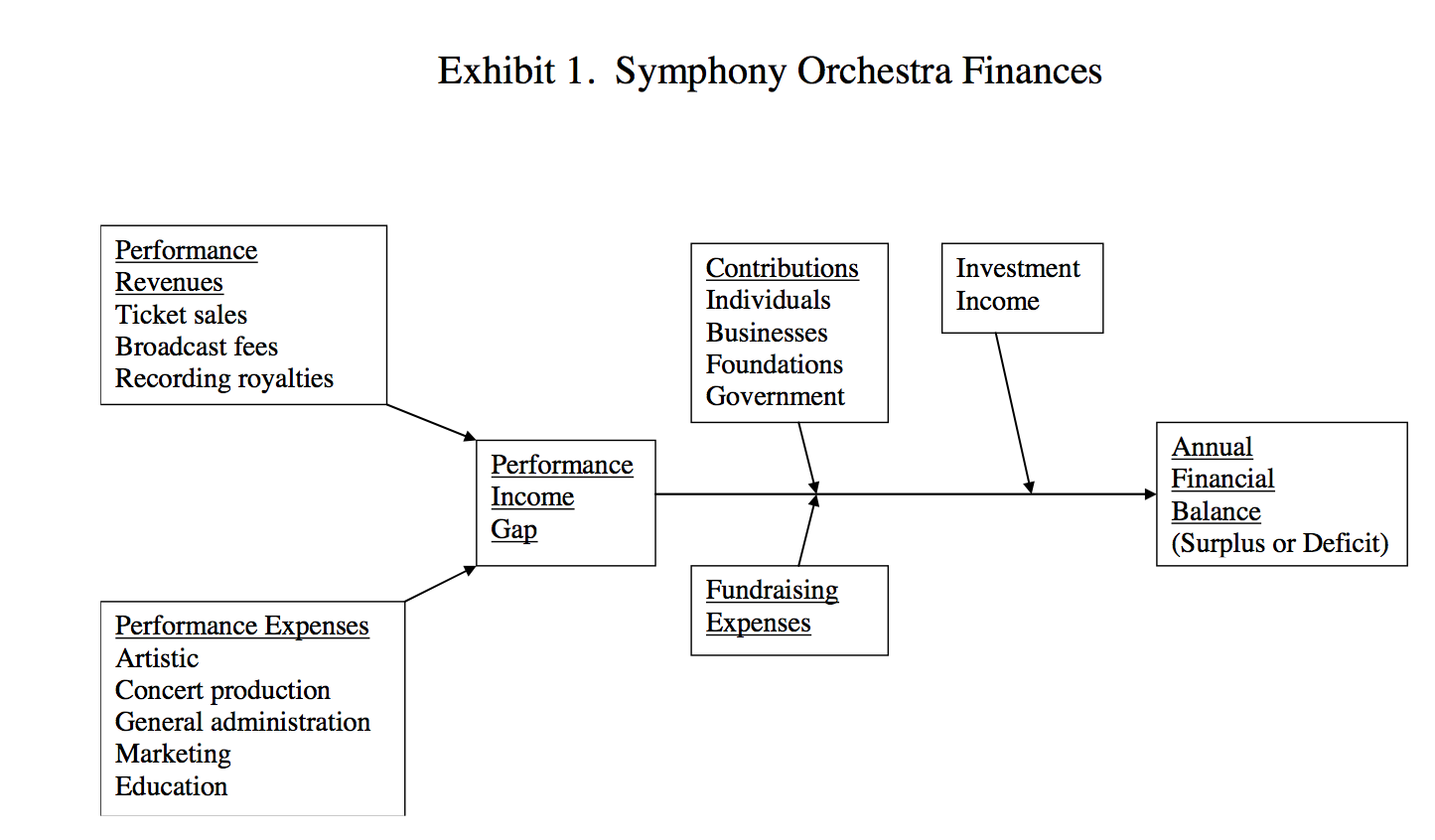
The “performance income gap” between what you can charge for a concert and what it costs to stage is largely bridged by contributions. Let’s assume for a moment that we can’t come up with a radically different economic model. Who is raising the money that builds the bridge?
One set of trends I’ve been following concern professional development. Here is a good study a on the subject from CompassPoint, nicely summarized in the Nonprofit Quarterly, but in brief:
- There are not enough qualified development directors to fill the available positions
- Organizations are suffering from high turnover and long vacancies in development positions
- Executives report performance problems and lack of basic skills among fundraising staff
The report concludes that development has to become a shared responsibility across the organization—an embedded part of many people’s work, not segregated into one specialized compartment. This is in accord with the general push for staff to develop “T-shaped” skills: deep in one area, but broad across a range of competencies. Nowadays, it isn’t enough for a curator to be an expert in her or his subject matter. A curator also has to be good at communicating to a variety of audiences, valuing the input of non-experts, and finding ways for people to participate in the creative process. Many people bitterly resent the fact that they can’t just focus on the skill at which they want to excel—I’m told this is a major tension in orchestras, as well. Many musicians who practiced long hours from a very young age and finally made it into a first rate ensemble, want to spend their time on making the best possible music. Understandable, but increasingly unrealistic.
To launch the Center, the arms of my “T” had to stretch to encompass editing, using social media, presentation, business planning and new product development. Now I, as a program staff member, feel like we (the subject specialists) have to learn to take point on raising funds to underwrite our work, as well. I can’t afford to land back at square one every time staff in the development department turns over—again. The time I spend teaching new staff about what I do, and how to speak about it to others, might be better spent delivering the message myself. Do I still want development staff supporting my efforts? Heck yes! But I think I had better not rely on them too much—in the end, no one can do a better job of convincing people of the importance of what I do than me.
So in the age of social media, celebrities, crowdfunding, and an increasingly unequal distribution of wealth, who raises the dough for orchestras? Here’s the brief story I wrote for closing event at LAO, a news item plucked from the headlines of 2023:
Congress Passes Arts Patronage Charitable Deduction Act,providing full tax deductibility for private support of individual visual and performing artists.On the heels of this news came a second announcement: a call for auditions for the New South Orchestra, a musician-founded organization dedicated to musical excellence. "A classical musician today has limited opportunities to focus purely on their art " said New South spokesperson, cellist Mia Lamm. "The majority of orchestras are premised on community service–even in the big six, musicians spend a significance portion of their time on social engagement, education and community service. The New South Orchestra is currently concluding a successful capital campaign to create a state of the art performance space and a modest endowment. For operating funds, our new orchestra has created a funding model that will allow us to focus on artistic excellence by expecting those most invested in that excellence—the musicians themselves, to fund the organization. Each musician, selected through a rigorous, global audition process, will be expected to bring with them to the job their own salary plus overhead. Some musicians will raise this funding through tapping their individual fan bases, built through social media and mobilized through crowdfunding; some (facilitated by the legislation passed today) will find individual patrons; some may fund their participation through personal wealth. This model will enable the New South to offer free admission to our performances, helping to build a broad & diverse audience for symphonic music.
The tweet version of this story? “People are sexier than their organizations.” I can imagine a future in which social media enables individual musicians to create avid international fan bases. Crowdfunding of musicians is already becoming mainstream—just last year Amanda Palmer raised $1.2M to self-finance her new album. And if current trends continue, in 2023 the top 1% may own over 40% of the wealth in the US (compared to the 36% they control now)—a crop of new Medici poised to be patrons of the arts. So dust off your social skills—both the social media and the cocktail party kind. In that future, funding will go to the creatives who learn to make their own pitch.
Categories: Museum [Tech] Blogs + Stuff
Ethics Smackdown: For the Resolution
June 26, 2013 - 8:51amThis is the fourth and (for now) final installment of our report on the debate held at the Alliance in May regarding the future of museum ethics. In today’s post, James Bradburne, director of the Palazzo Strozzi in Firenze, Italy, makes the case for the resolution:
Resolved: American museums should revisit the Code of Ethics for Museums and relax the restriction on the use of funds from the sale of deaccessioned collections.
The Code of Ethics for Museums states: “Disposal of collections through sale, trade or research activities is solely for the advancement of the museum's mission. Proceeds from the sale of nonliving collections are to be used consistent with the established standards of the museum's discipline, but in no event shall they be used for anything other than acquisition or direct care of collections.”
This debate is not about de-accessioning, which American museums consider legitimate, but the use of the funds generated by de-accessioning. We are also not arguing about the elimination of the concern that the well-being of the museum must be the first priority. What is being debated is the need to change the specific wording of the current Code of Ethics in order to allow funds raised by de-accessioning to be used across the full spectrum of the museum’s mission, as determined by its Trustees and Statutes.
Point 1. THE WORDING OF THE CODE OF ETHICS IS CONFLICTED. In the first phrase it rightly asserts that any funds realized by sale of museum assets should be used to further the museum’s mission (rather than paying dividends, taking holidays in Rio etc.). This is clearly a correct ethical stance. However, the last phrase limits the use of the funds solely to one – sometimes secondary – part of the museum’s mission: “acquisition or direct care of collections.” Even if we respect Robert Veach Noble’s definition of the museum’s mission ‘to collect, preserve, study, interpret and exhibit’, which has been superseded by more recent, more vague ICOM definitions, the museum mission – and its stewardship – is not only of collections, but of the historical, scientific and social value their interpretation and exhibition represents. To privilege collection and preservation over interpretation and exhibition seems willful and unwarranted.
Point 2. WHAT IS THE VALUE OF A MUSEUM? The Code assumes that a museum has the responsibility, as a steward of material held in the public trust, to maintain the value of the collections —that total value can be allowed to expand, but never contract. But the notion of value is highly elastic, in both quantity and in quality. The value and nature of museum assets are not stable – they vary with time. As an institution deeply involved with time, the museum cannot exempt itself from history. An Impressionist purchased in Paris in 1903 as an unknown or emerging artist, a purchase that may have represented a small percentage of the museum’s acquisitions budget, acquires a value of millions as the markets increase the value. The costs of insurance make it impossible for the museum to afford keeping the work. However, if the value of the object has increased over time, why should the full sale value be re-invested in the collections? Preserving collections is not the only “public trust” responsibility of museums. We already acknowledge we are responsible for more than merely storing collections. We have equal responsibilities to share our content in meaningful ways that are accessible to a broad swathe of the public. Seen in this way, a museum’s resources are a portfolio that can be distributed across many investments: in collections, staff, facilities, infra-structure and delivery mechanisms. Creating a portfolio that is profoundly unbalanced (for example, investing in the building while understaffing its functions, or maintaining collections without building the capacity to make them accessible to the public) is not acting as a good steward of the resources it holds in the public trust.
Point 3. WHAT IS THE GOVERNING AUTHORITY’S HIGHEST RESPONSIBILITY? It has long been accepted that a governing authority’s primary responsibilities are the duties of care, loyalty, and obedience: Care of the museum’s resources; loyalty to the museum before personal concerns, obedience to the mission. The consequence of the current ethics restriction leads to a potentially self-destructive situation in which, by making maintaining the value of collections the overriding concern, the governing authority neglects its other duties. An institution could collapse entirely at the same time it was using resources, per the Code, to increase or preserve its collections. This is the argument of the cancer cell: the right to grow and thrive at the expense of the host. Our overall responsibility is to maintain the health of the organism, not the individual cells. Many museums have a wide variety of ‘objects’ in their collections: a hands-on science centre, with a mission to foster a working understanding of science, may accomplish that mission through interactive exhibits, paintings, working models etc. For that science centre to sell a painting to build an interactive exhibit – does this violate the Code of Ethics?
SUMMARY ARGUMENT. As with so many issues that museum professionals would like to characterize as being about “standards” this argument is really about difficult and subtle choices regarding rights, responsibilities and stewardship. Museums often want clear guidelines that would relieve them of the need to have messy, uncomfortable conversations. They want a “standard” that there should be term limits for the board, so that they don’t have to ask an underperforming board member to step down. They want there to be a “standard” that the temperature and RH be exactly X or Y, so they don’t have to justify to the board the investment they want to make in environmental controls. For the most messy and uncomfortable issues, they up the ante by characterizing an issue as being not just about standards, but about ethics. Should a museum board member be allowed to exhibit their collection? How handy if one can politely evade the issue that theirs is a subpar collection by saying “ethics say we can’t do that.” If you do accede to an exhibit, much easier to say “you can’t ethically be involved in developing the exhibit or its interpretation [even though you are an amateur expert, steeped in the topic for many years]” rather than negotiating a productive dialog between the board member and the curator, drawing and enforcing reasonable boundaries.
I put to you that the argument regarding ethical restrictions on the use of funds from deaccessioning has taken exactly this lazy path of avoiding a deeper exploration of the issue. What are a museum’s overall stewardship responsibilities to its public? When is a board trying to use deaccessioning as a fast and irresponsible way to raise funds, and when are they making reasoned and reasonable choices about allocation of resources within a museum’s portfolio of stewardship? Why should the fluctuating and largely arbitrary monetary value of a museum’s collections dictate so many of its other choices? Ethics should be boundaries that delineate realms where we can never safely venture, not excuses to avoid exploring unmapped but navigable terrain.
Most importantly of all, perhaps, is deciding what we believe of existing museum governance and governors, and, as a consequence, where we choose to intervene in creating an ethical framework. If we believe that museum governance is inherently flawed, and that trustees cannot be trusted to understand the museum’s mission and act in its best interests, then the correct place to intervene is not in restricting the board’s ability to decide how to use funds, but in strengthening the rules that have an impact on the museum’s governance – how it selects trustees and what informs their decisions. If, on the other hand, we believe that museum governance is robust, and that museum boards and trustees as a rule act in the best interests of their institutions, then it makes no sense to limit their use of funds to a single – and not always central – aspect of the museum’s multi-facetted mission.
Your turn: I encourage you to review my introduction to this series, Sally Yerkovich's preamble to the Smackdown, and John Simmons arguments against the proposition and then weigh in, below. Which argument do you find most compelling? What reasoning would you advance that has not yet been brought to bear? This is not an academic debate--it is one that my have very real consequences for museums and the standards to which we choose to adhere.
Categories: Museum [Tech] Blogs + Stuff
Do You Want to Live Forever?
June 25, 2013 - 9:00amPhil and I read far more broadly than we can travel, so when Rohit Talwar of Fast Future was kind enough to arrange a complimentary registration to the Global Futures 2045 conference in New York City earlier this month, we tapped Paul Orselli, President and Chief Instigator at POW! (Paul Orselli Workshop) to attend on our behalf. Little did we realize we were sending Paul into a convening of transhumanists (who believe we are on the cusp of discovering how to upload human consciousness into machines.) I’ve written that scanning should encompass fringe as well as mainstream sources. Consider this your monthly dose of news from the fringe.
When the fine folks from AAM’s Center for the Future of Museums (CFM) asked me to attend a “futurism” conference at Lincoln Center in New York City, I jumped at the chance.I imagined discussions and demonstrations regarding robots, space, nanotechnology, biotechnology, and the like. I expected that an international conference entitled GF2045 (Global Future 2045) would stretch my mind in unexpected ways.
Which it did. But little did I realize that the primary focus of this conference would be, in a word, immortality. Immortality as in living forever. Immortality as in downloading the complete contents of your brain, your human essence, into some sort of machine. I looked at the back of my fancy plastic nametag that I received upon check-in to discover what I would characterize as the GF2045 “manifesto” from the Conference’s founder, Dmitry Itskov:
“Cyborgs or AI would not cause a civilization catastrophe. Homo Sapiens’ primitive, selfish, short-sighted thinking however could. If we are willing and able to change that mindset and change the world, then why would we have to die in this new world? Why would we not have the right to choose? Why would immortality not be part of a positive scenario for human development?”
And now I’ll admit that I started to get intensely uncomfortable. (I’ll also mention parenthetically that I had just gotten off a red-eye flight from Albuquerque a few hours before at JFK and came directly to Manhattan, so I was feeling a bit fuzzy.) Was this really the conference I had committed to attending for two full days!?!?
I took a deep breath and started scanning the Conference program for reassurance. Here were some of the session titles that immediately jumped out at me: “Intelligent Self-directed Evolution Guides Mankind’s Metamorphosis Into An Immortal Planetary Meta-Intelligence” (had to read and parse that one several times!) “The Goal of Biotechnology is the End of Death“; “Whole Brain Emulation: Reverse Engineering A Mind” and “How Human Consciousness Could Be Uploaded Via Quantum Teleportation.”
Clearly, even as a science person, I was in over my head. WAY over my head. But what could I do? I had made a commitment to the CFM team, and really isn’t the point of a Futurism Conference to push us out of our comfort zone, and make us think beyond mere incremental steps and predictions about what lies ahead?
With another deep breath, I grabbed a seat near the rear of the Alice Tully Hall auditorium inside Lincoln Center and told myself that I would resist judging the content being presented and just experience the ideas of the conference as they happened and try to take notes to be able to mentally unpack and collate my thoughts.
So allow me to unpack my “mental laundry” a bit and share my impressions of the future as viewed through a decidedly GF2045 lens:
There are clearly many completely sincere people from a variety of spheres: science, spirituality, engineering, and business who firmly believe in the importance and efficacy of pursuing the goal of human immortality.
Personally, I still find the notion of immortality (even in the digital brain download sense) baffling. I love life, but I do not want to live forever. Nothing I heard at the GF2045 Conference has changed my personal ideas about that. It often felt like answers in search of questions. Nigel Ackland & his Bionic ArmHowever, having the opportunity to see Dr. Hiroshi Ishiguro’s robotic “avatars” or to hear the gratifying story of Nigel Ackland who lost his arm in an accident, and then to see his amazingly cool prosthetic arm controlled by his brain gave me enormous hope for the future and the continuing intersections of human ingenuity and technology.
So perhaps, in the end, immortality is in the eye of the beholder. Perhaps a different measure of immortality is not an individual life lived forever, but rather a collective human spirit that leads into the future, pushed forward by interesting ideas and discoveries contributed from all of us.
You can read an extensive review of the conference with a list of speakers in Digital Trends, and hear Dimitri Itskov on the subject of immortality for yourself in this video.
Categories: Museum [Tech] Blogs + Stuff
Ethics Smackdown: Against the Resolution
June 20, 2013 - 9:00amThis is the third installment in our report from the Ethics Smackdown at the Alliance annual meeting, debating whether museums should loosen the ethics restrictions governing the use of funds resulting from the sale of deaccessioned collections. In today’s post, John E. Simmons, principle of Museologica, Adjunct Curator of Collections,
Earth and Mineral Science Museum & Art Gallery
Penn State University
and
Lecturer in Art
Juniata College
, Huntingdon, Pennsylvania, summarizes the arguments against the resolution.
Resolved: Whereas, cultural, financial, technological and political trends are changing the world in which museums operate, American museums should revisit the Code of Ethics for Museums and relax the restriction on the use of funds from the sale of deaccessioned collections.
Deaccessioning is necessary to maintain a healthy museum—the issue is how funds generated from the sale of deaccessioned objects should be used. Deaccessioning should be a tool to improve and refine collections, not a source of income.
Using deaccessioning proceeds for anything other than “acquisition or direct care of collections” violates the principle that collections are held in the public trust. Museums and businesses play by different rules, and for good reason. Most U.S. museums are nonprofit, tax-exempt organizations that carry out their missions for the benefit of the public. Because most museum property is held for charitable purposes, museums are legally treated as charitable trusts. This special status is strictly defined and tightly regulated by the Internal Revenue Code of the United States, and it means that museums have both legally mandated and implied responsibilities, including the duty to care for and manage their collections. Nonprofit, public trust status is not to be taken lightly—in 2011 the Internal Revenue Service revoked the tax exempt status of 275,000 organizations, including many museums, for failure to comply with legal requirements.
Nonprofits are given their special legal status to allow them to take on tasks that are socially desirable, because they usually operate at the limit of their resources, and because they provide a benefit to the public. A Legal Primer on Managing Museum Collections puts it this way: “When a for-profit organization faces a financial crisis, the sale of part of its assets is essentially a matter of business judgment… For a nonprofit, the sale of assets can mean (as in the case of a museum) the disposal of part of its very reason for being.” Holding collections in the public trust does not mean that a museum must keep every object in its collections; rather, it means that a museum must ensure that the objects help fulfill its mission, and that collection objects are not treated as a source of ready cash.
Allowing deaccession proceeds to be used for general purposes will turn collections into financial assets that have no greater worth than their market value, presenting an irresistible temptation to boards and administrators. Fair market value rarely reflects an object’s research or scholarly value (which is dependent on its documentation) or cultural value (which is dependent on its associations). Calculating the monetary worth of a museum object is necessary for purposes of insurance, but it does not begin reflect how much objects are worth as part of a museum’s collection. Collections are the heart of the museum—everything that a museum does, including exhibitions, pubic programs, research, and the acquisition of more objects—is based on the use of its collection. Liberalizing the ethical standard would have a negative effect on supporters and future donors, who would see that the museum valued their donations only for their cash value, not for their cultural or scholarly value. Deaccessioning for cash is very a bad public relations move, and may force the museum into court.
If the ethical standard is revised, collection objects will be sold to pay for pet projects, building expansions, salaries and bonuses, to cover debts, and in other ways that offer an escape from fiduciary responsibility. It isn’t just museum professionals who make decisions to deaccession for cash—it is often the museum’s parent organization, which leaves university museum particularly vulnerable to the plundering and pillaging of their collections. We know that deaaccesioning for cash will take place on a large scale because there is a long history of it despite the ethical standard. For example, in 2007 Randolph College sold four paintings from the Maier Museum of Art to help balance the university’s general budget; the local paper called it a “targeted heist.” In 2008, the National Academy Museum sold two paintings for $13.5 million to shore up its troubled finances. Following a devastating flood at the University of Iowa, the state legislature attempted to force the university to sell its Jackson Pollock mural to help pay for $743 million in flood damages. In 2009 Brandeis University announced plans to shut down the Rose Art Museum and “monetize” its collection to make up the university’s budget shortfall. The Western Reserve Historical Society sold $3.2 million of collection objects to help pay a debt of $5.3 million. In 2010, Fisk University sold a 50% share of its Georgia O’Keeffe paintings to the Crystal Bridges Museum for $30 million, of which the university was allowed to use 1/3 to pay its debts; the paintings are now shipped back and forth between Nashville, Tenn., and Bentonville, Ark., every two years. In 2011, the New Jersey Historical Society sold artifacts to pay off a $2.1 million debt; the local paper described the museum as cannibalizing itself to survive. In 2012, it was reported that the Field Museum, which had already sold more than $15 million worth of George Catlin paintings, might sell more collection objects to cover its debts—five years previously, the board had issued $90 million in bonds, doubling the museum’s debt; at the time, the Chicago Tribute described the board’s financial plan as “fraught with risk.” Although behind all of these examples we can find worthy goals and good intentions, we can also find financial recklessness and absurd predictions for future income.
The present ethical standard allows broad use of deaccessioning proceeds while keeping museums focused on their missions. As any ethical standard should be, this one has already been re-evaluated and revised. The 1991 edition of the code stated that the use of deaccessioning proceeds was “…restricted to the acquisition of collections;” this was revised in 1994 to “…acquisition or direct care of collections.” The meaning of “direct care” has been interpreted widely, both in museum practice and in the courts. When deaccessioning proceeds are used to care for the collection, it means other sources of income can be diverted to other museum needs.
Finally, if the museum is in dire financial straits, in most cases it is due to fiscal mismanagement, so selling off the collections won’t help, it will only cripple the museum in the future. An analogy can be made to a hiker who is lost in the woods at night and sets his map on fire to find the trail. That’s a really bad idea—the hiker should tough it out until daylight. It might be uncomfortable, but at least when the sun comes up he will still have a map to read.
In the next installment, James Bradburne of the Palazzo Strozzi in Firenze, Italy summarizes the arguments for the resolution.You can order a recording of the session here.
Categories: Museum [Tech] Blogs + Stuff
A Case Study in Survival from the Sacred Realm
June 18, 2013 - 9:00amMuseums can learn a lot by looking at how other sectors—for-profit and nonprofit—are responding to the same trends and events that shape our operating environment. Religious communities, for example, are challenged by changing demographics, shifts in audience expectations, aging infrastructure, and finances—forces that confront many historic houses and historic sites. So I was particularly pleased that Karen DiLossi, director of Making Homes for the Arts in Sacred Places at Partners for Sacred Places, agreed to share a story drawn from her experience at the intersection of the secular and sacred worlds.
Adapt & Change, or Die—they’re blunt choices that confront the historic churches and synagogues in the U.S. in our changing times. At Partners for Sacred Places, we encourage organizations to focus on the “adapt” and “change” options, and I want to share one example of how that approach is catching on.
Worship services at all too many mainstream churches once commonly hosted 1000 members or more, including people of all ages, now attract only 30-100 attendees, mostly senior citizens. Most of these congregations have moved their services to annexes, basements, or fellowship halls because the main sanctuary is too costly to heat. Facing bills upwards of four or five thousand dollars in the month of January, these congregants may be thankful, in a strange way, for global warming.
Climate change is not the solution, of course, and neither is business as usual when your historic worship site’s beauty and future are on the line. Pastors who have a global perspective and who want their large facilities to be used for their entire community—as it once was 100 plus years ago—are turning to artists to fill their empty halls. For example, Philadelphia’s Hidden City Festival, brings the public into many kinds of historic buildings, including churches, in a celebration of “the power of place through the imagination of contemporary artists.” But this festival and others like it, while wonderful at getting the public into these houses of worship and putting a media focus on them as well, are episodic and their effect fleeting. Once the festival is over public attendance and media’s attention fade.  Interior of Shiloh Baptist before Brian Sanders' JUNK
(Photo credit: Partners' staff)How can art be embedded in places of worship in an ongoing fashion? Shiloh Baptist Church, located in a gentrified neighborhood of Philadelphia, is a great example of how a church can go from a closed-door facility to a “church is for more than just Sunday” arts facility. Under the leadership and vision of their Pastor, the Reverend Edward Sparkman, Shiloh Baptist has chosen change, and adaptation, in order to alter the course of their future. Their Frank Furness designed facility has at least an acre of space within its three buildings. On the second floor of one annex building alone, there is a 3500 square foot former Sunday School room with a ceiling height of 35 feet, a small chapel of 1500 square feet, a full size basketball court and two dining rooms that are each larger than most NYC apartments.
To capitalize on this beautiful unused space, Rev. Sparkman participated in the Hidden City Festival. With three exhibits within its massive structure, Shiloh was a highlight of the 2009 festival, convincing the Reverend that there was more to be mined in this approach of using arts to repurpose sacred space. The Reverend decided to try welcoming artists into Shiloh Baptist on a long-term basis, encouraging them to invest in maintaining and improving the space. The church has allowed these artists to come in and out at any hour, and to use their location to expand their reach with classes, mentorships, or apprentices. Are these artists members of the church? No. Are these artists awed and inspired by their new surroundings? Yes. They are also happy to have stable rental space, with no fear of eviction, at paying rent that compares favorably to retail or commercial rates. They are now solidly hooked into the church community.
Creative and loving artist, meet charming and charismatic pastor.
This relationship is still evolving, but currently Shiloh Baptist, with its beautiful facilities, caring pastor, and aging congregation, is home to three arts groups: A dance company, a theatre company, and a freelance theatre professional.  Interior of Shiloh Baptist after Brian Sanders' JUNK
(Photo credit: Partners' staff)
- Brian Sanders’ JUNK, a company who dances both on the floor and suspended in the air, has found their home in the Sunday School room.
- Brat Productions, a rock and roll theatre company who lost their free office at another facility, is solidly at home and at peace.
- By moving into the Shiloh Baptist space, Madi Distefano, AEA actress and professional director, was finally able to separate her work from her home.
Two more artists are interested in taking over a former Boy Scout room on the third floor of one of their buildings.
The lesson imparted by Shiloh Baptist’s experience is: look beyond your organization and your own capacity. Sharing means caring and more importantly sharing can give you the ability to politely decline the unattractive option of “or die.”

 Cartoon from Techgig.com
Categories: Museum [Tech] Blogs + Stuff
Futurist Friday: The Great Inversion
June 14, 2013 - 9:00amHere’s a good medium-length read on the rise of the city (one of our feature topics in TrendsWatch 2013): an article by Edward Luce in the Chicago Tribune on The Future of the American City, documenting the revitalization of the urban core “as the suburbs become the new home of the poor.” [~4,000 words]
It includes a great counterpoint to the prevalent “Detroit is dying” narrative, documenting how downtown Detroit is attracting new employers and new residents, particularly the young, creative class. (And Luce gives a shout out to the DIA as one of “America’s finest…institutes of art,” helping make the city an attractive place to work and live.)
Some of the forces Luce describes as driving re-urbanization are:
- Gen Xers, to whom the suburbs they grew up in represent a “poverty of living”
- Baby Boomers growing bored of the suburbs, too
- The increasing proportion families without children
- The rise of independent charter schools which give families the option of staying in the city wen their children reach school age
- The rising importance of “Place-based” shopping as online retail erodes the primacy of the mall
- Growing urban investment in mass transit, with coincides with Millennial aversion to car ownership
- A growing cadre of activists who bypass dysfunctional local government to work directly with the private sector on community revitalization
The story also paints a grim picture of the growing divide (Luce characterizes it as a moat) between booming downtowns and impoverished city neighborhoods, and of rising poverty in the suburbs, where hardship is often easier to ignore, and harder to address.
Some questions that occurred to me (you can contribute others in the comments section, below):
- How can museums join the ranks of “social entrepreneurs” actively contributing to urban rebirth?
- How can museums help bridge the moat within the city between neighborhoods with attractive cultural amenities, and those without?
- How can museums find, and serve, the suburban poor, who face even greater barriers (transportation, cost) to accessing cultural resources than their urban counterparts?
Categories: Museum [Tech] Blogs + Stuff
Ethics Smackdown: Preamble
June 13, 2013 - 9:00amLast week I wrote about the Ethics Smackdown that took place at the Alliance annual meeting last month. This week, Sally Yerkovich, director of the Institute of Museum Ethics at Seton Hall University and moderator of the debate, sets the stage for the arguments for and against the proposition to revisit the Alliance Code of Ethics.
In the spring of 2011, Seton Hall University’s Institute of Museum Ethics began to talk with the Center for the Future of Museums at the American Alliance of Museums about working together on a project dealing with ethics in museums. We agreed that ethics, like other cultural values, change over time and wondered how the many changes we are seeing today -- in the global economy, demographics, and technology, among others -- will affect museum practice.
We speculated that it would not be surprising to find that the ethical principles that guided professional practice even just a little more than ten years ago when the AAM Code of Ethics was last revised might continue to change dramatically over the next ten to twenty-five years. And while museum professionals make decisions about ethical issues on a regular basis, we tend to think together about them only when a crisis arises. So we asked if there might be something that we could do to start a constructive and future-oriented dialogue about ethics in our field.
We decided to embark upon a forecasting exercise to identify some of the critical issues that may need to be addressed in a future revision of the Code of Ethics and were pleased to find that there were many people interested in working with us on this. We approached close to two hundred museum professionals -- from emerging professionals to senior experts, from educators to registrars, public relations staff and fundraisers to directors -- as well as professionals from related fields like librarians and archivists, attorneys, journalists, and even futurists and ethicists.
Of these, seventy-nine agreed to participate in a forecasting exercise that would take place on the Internet. In addition, we invited public participation and had over one hundred members of the general public weigh in on various aspects of the project.
The forecast identified six issues likely to be of profound importance to museums in the next ten to twenty-five years. They are:Accessibility -- encompassing the whole range of questions related to ease of access
- Accountability and transparency in governance, operations, and finance
- Conflict of Interest on several different levels -- governance, staff and donors
- Control of content, again a broad category dealing with everything from curatorial independence and public participation to censorship
- Diversity; and
- Collecting and deaccessioning
Of all of these groups of issues, it was the last, and in particular how the Code of Ethics should change regarding the use of funds from the sale of deaccessioned collections, that was the most controversial.
There was no consensus about how the Code should change but there were strong feelings about every possibility. About half of our forecasters predicted that the restrictions will be loosened; twenty percent through they will remain about the same (although perhaps subject to greater public scrutiny) and the remainder, around thirty percent, felt that restrictions on deaccessioning will be tightened.
The current Code was written, for the most part, to be very general and non-prescriptive. It was designed to apply to museums of all types and sizes (from an historic house with $50,000 in annual operating expenses, to a zoo with a $50 million budget). And in part it reflects the inability of the field to come to consensus on some issues, such as the definition of “direct care.” It is clear from the forecasters’ comments, however, that there is now a hunger for more clarity and guidance.
Comments on all side of the issue were impassioned. There were calls for clarity,
“These policies are already way behind the eight ball in terms of the fields need for reasonable guidance and standards. In our zeal to avoid making rules, or the inclination to make "one size fits all" rules for the field, we have done the field a terrible disservice.”
There were calls for change,
“AAM's standards about the use of funding for deaccessioning is stuck in the 20th century. Pretty soon, we'll have tons of stuff but no museums left to reach audiences.”
And there were calls to protect the collections entrusted to museums,
“AAM and other national and state organizations need to step it up and ensure that the nations treasures stay put or go to other museums for care and not into private collections.”
We are not surprised by the passion expressed in the forecasters’ comments on this issue. Deaccessioning, and use of funds from deaccessioning, is perennially a huge issue for museums, with many seeing an ethical prohibition as the only way to keep governing authorities, or parent organizations, from raiding the cultural till. Some of our forecasters were recruited from outside the museum field, however, and had different observations,
“As someone who is not an insider to the museum world, I really think this issue is a ridiculous tempest in a teapot. As long as institutions aren't creating a massive black market for famous works and selling off items from the permanent collection on a regular basis, I can assure you that NOBODY CARES about deaccessioning outside of a few academics and museum nuts. In general, there is a movement in the nonprofit sector to place less importance on administrative cost ratios and more importance on whether an organization is accomplishing its mission. If a few works have to be sold in order to keep a museum alive, even if that money pays down debts or whatever, to me that is in keeping with the mission.”
So, with that as background, we proceeded to explore some of the issues surrounding the use of funds from deaccessioning and to debate the motion:
American museums should revisit the code of ethics for museums and relax the restriction on the use of funds from the sale of deaccessioned collections.
Stay tuned next week for part three of this series: the arguments against the proposition.
Categories: Museum [Tech] Blogs + Stuff
The (Ever) Changing Shape of Giving
June 11, 2013 - 9:00amAt the rate the world changes, CFM will never run out of work. It’s only four months since we released TrendsWatch 2013, and already my co-author, Phil, and I are scrambling to assemble updates.
This post shares some of the material we’ve compiled recently on the future of philanthropy. We also want to invite you to join us for an Alliance Town Hall webcast on the topic.
Webcast info first: Jacob Harold, CEO of GuideStar, and Laura MacDonald of the Benefactor Group will join me on Thursday, June 13 from 2-3 pm for discussion on the future of philanthropy. Jacob and Laura will share their observations on trends and events shaping giving in the US, and field questions from the online audience. Town Halls are free to individual Alliance members and staff of Museum, Ally and Industry members. Non-member registration fee is $50. You can read more about the Town Hall and register here.
Whether or not you attend the Town Hall, I recommend the following readings related to this topic. (If you are planning to attend the Town Hall, I highly recommend this reading, as we may riff on the content in the discussion, and it may inspire questions you want to lob at our speakers.)
In Ten Legacy Goals of Next Gen Grantmakers Albert Ruesga reports for the Nonprofit Quarterly on a discussion with “younger philanthropic careerists” at a Council on Foundations program, in which he asked them what they hoped to be remembered for in philanthropy. A good brief read. Isn’t it important to know what motivates the next generation of foundation staff?
The Millennium Communications Group recently completed a “Donors of the Future Scan,” identifying 12 key trends in the giving landscape that will drive change. Interesting questions raised by the scan include: Will the concept of endowment be challenges as new donors give preferentially to non-endowment options? Will more philanthropic dollars flow from inside the US to outside projects? Will “flash giving” in response to disasters affect traditional giving? And (related question) will the rise of mobile giving erode place-based philanthropy? A good longer read. Here is a summarywhich contains a link to the full report.
This Forbes article explores What it Means to Be A Philanthropist—Gen Xers and Millennials Weigh In, summarizing results from the Next Gen Donors report. Some of the highlights: These donors want to make a bigger difference, and to integrate social responsibility into their lives, not just their giving. They want to combine social and financial value, sometimes via impact investing. They see their philanthropy as part of their lives, not as something that will happen when they retire. Here is another article on the Next Gen report, this one from the New York Times, focusing on the implications for family foundations.
Finally, this report from the Bridgespan group examines Philanthropy in the New Age of Government Austerity. (It could have been titled “advocacy as a zero sum game,” as government programs of all types compete for an ever-shrinking pool of funds.) The Bridgespan report discusses three approaches philanthropic organizations can use to engage with the government in this climate: investing in government institutions (such as public schools); helping nonprofits attract government funding (by investing in nonprofit capacity); collaborating on government reform.
We will continue to share links to new articles and reports of interest in the weekly e-newsletter Dispatches from the Future of Museums. When I tweet links from @futureofmuseums on this topic, I use the hashtag #philanthropy. (Whenever I can fit that into the tweet, anyway.)
I look forward to discussing millennial donors, family foundations, impact investing and other trends in philanthropy with Jacob, Laura and with you this Thursday!
Yours from the future,
Elizabeth
Categories: Museum [Tech] Blogs + Stuff
Futurist Friday: Interview with Garry Golden
June 7, 2013 - 11:14am Garry Golden is a professional futurist. (Yes, it is a profession. I myself am a proud member of the Association of Professional Futurists.)
I met Garry through our shared academic lineage--he is a full fledged graduate of the University of Houston's Strategic Foresight program; I took their one week crash course when I was handed the assignment of founding CFM. The director of the UH program. Peter Bishop, became one of the founding members of the CFM Council, and introduced me to Garry. Now Garry has succeeded Peter on the Council, and is my futurist mentor and frequent collaborator.
In a couple of weeks he and I will be presenting at the League of American Orchestra's conference in St. Louis. In the course of preparing for that gig, I re-viewed a series short video interviews with Garry on the Kennedy Center's ArtsEdge site. In these interviews Garry introduces himself and discusses:
- Arts Experiences and the Rise of Third Place. (Garry has also written on the CFM blog about the growing importance of Third Place.)
- The Role of Educators in a dynamic arts education landscape
- The Future of Work including the opportunities created by social networks and the growing need to develop an online portfolio of work
- Effecting Change and the future of learning management systems
- Emerging Technologies including Kinect, Siri and IBM's Watson
If you have questions for Garry, post them in the comments section, below, and I will nudge him to reply.
Categories: Museum [Tech] Blogs + Stuff
The Future—Brought to You By
June 6, 2013 - 8:30amEver wonder how CFM can deliver so much content to the field for free?
I get that question a lot, from museum professionals as I travel, and from staff of other associations wondering how they might create their own CFM-equivalent.  The answer? It’s made possible by members of the Alliance —people and institutions who support the field through their dues. This is my shameless plug for your museum to be one of these supporters.
Here are just some of the resources that membership dollars have enabled us to create and share with you, in the five years since the Alliance launched CFM:
- 3 public lectures disseminated via the web (Dr. Jane McGonigal’s on the application of games design to museums; Gregory Rodriguez on the changing demographics of the US; Jessica Harris on using food to nurture community connections);
- 4 reports on issues of importance to museums (Demographic Transformation and the Future of Museums, Tomorrow in the Golden State: Museums and the Future of California; Feeding theSpirit: Museums, Food & Community, Museums and the Future of Education)
- 3 trends reports (Museums & Society 2034: Trends and Potential Futures, TrendsWatch 2012 and TrendsWatch 2013)
- 1 weekly e-newsletter, Dispatches from the Future of Museums, that goes to over 20k subscribers
- The CFM Blog, featuring 2-4 posts a week that relay news, highlight museum practice, share resources and point to opportunities
- A Twitter stream of links to more news, resources and opportunities (and also periodic Tweet Chats on topics of interest)
- Opportunities for museums to participate in cool projects run by or instigated by cool folks (the Institute for the Future’s Massive Multiplayer Alternate Reality Game Superstruct; The World Bank’s Evokegame, Seton Hall’s Institute for Museum Ethic’s Forecast of the Future of Museum Ethics)
- Access to funding (Innovation Lab for Museums grants provided by MetLife Foundation for participation in EmcArt’s innovation program) and discounts (off the registration fee for the University of Houston’s Certificate in Strategic Foresight short course)
It’s easy to take such resources for granted, since nowadays you can swim in a sea of free content on the web. But high quality, thoughtfully selected content still has value, and it has a cost. Businesses from Google to Facebook to Coursera are trying to figure out sustainable business models for this ocean of information.
Founding CFM was an early step in the evolutionary path that resulted in AAM reinventing itself as the American Alliance of Museums. We are trying to create a sustainable business model that will enable us to serve allmuseums in the US (and a burgeoning number across the globe).
The Alliance’s ability to provide key products and services for free—our core publications Standards and Best Practices for US Museums and Speak Up for Museums (free to all members), the Center for the Future of Museums, our advocacy on behalf of the field—is an outgrowth of the ongoing work that is funded in large part by our member dues.
So if you want to support our work, please do this:
- If you would like to become an individual member of the Alliance, you can join here
- If you work at a museum, check to see if your employer is a current member of the Alliance (instructions below*)
- If the museum you work for is not a member, please join! There is an affordable option for every institution—from “pay what you can” tier 1 membership to a benefit-rich tier 3. (You can find a run-down of the choices here)
- If your museum is a lapsed member, please take a few minutes to renew(This is tremendously important. One thing I have learned about business models as I tweak CFM—even a couple of months lag in renewals can mess up a whole year’s income.)
If someone else in your institution makes decisions about the museum’s professional memberships, please send them a link to this blog post, along with your personal endorsement of the value of the work we do. (Heck, sign them up for a subscription to Dispatches while you’re at it.)
However you choose to support our work—through individual or institutional membership---thank you thank you thank you. If you send me a note that you joined or renewed--I would love to make that a personal thank you. Or if you choose not to join or renew, please tell me about that, too--I'd like to hear why.
*How to check on whether you, or your museum, is a member of the Alliance
- Log in to your existing account. If you haven’t interacted with AAM before, create a new account by clicking Login at the top of the page.
- Click on Edit Profile, then view your museum’s membership status in the Employment Information tab
Yours from the future,
Elizabeth
Categories: Museum [Tech] Blogs + Stuff
Ethics Smackdown: A Preview of the Future?
June 4, 2013 - 12:54pmI returned from the Alliance annual meeting in Baltimore to find my scanning feeds clogged with a spate of articles about the threat of the state-appointed emergency manager selling collections from the Detroit Institute of Arts to help resolve the city’s $15.6 billion debt. (While the museum is operated by a private nonprofit, the building and the majority of the collections are owned by the city.)
These stories demonstrate the timeliness of one of the Baltimore sessions—the “future of ethics” debate CFM engineered with the Institute for Museum Ethics at Seton Hall University. The origin of this Ethics Smackdown was the Forecast on the Future of Museum Ethics conducted jointly by IME and CFM last year, in which half of our forecasters thought that restrictions on the use of funds resulting from deaccessioning will be loosened in coming decades.
For the Smackdown, we recruited two eloquent and experienced speakers (John Simmons of Museologica and James Bradburne of the Palazzo Strozzi in Florence, Italy) to argue the following proposition*:
Resolved: Whereas, cultural, financial, technological and political trends are changing the world in which museums operate, American museums should revisit the Code of Ethics for Museums and relax the restriction on the use of funds from the sale of deaccessioned collections.
You might take the position that our field’s internal debate about museum ethics is only tangentially relate to the situation in Detroit. Most of the high-profile cases regarding non-compliance with the Code of Ethics involve the actions of non-museum parent organizations, notably colleges or universities (see Randolph College/Maier Museum of Art; University of Iowa/UI Museum of Art; Brandeis University/Rose Art Museum; Fiske University & Crystal Bridges) or, in this case, a city. One can argue (and university administrators often do) that a college, or a city, isn’t a museum and isn’t bound the codes of ethics of the museum field. Certainly it has been pointed out that the Detroit’s emergency manager is primarily responsible to the city’s creditors, not to its cultural heritage.
But the Detroit case has already rebutted the comment of one of our forecasters, who wrote “I can assure you NOBODY CARES about deaccessioning outside of a few academics and museum nuts.” Evidently, this is not so. The Senate Majority Leader of Michigan has introduced a bill that would protect the collection by requiring the DIA to abide by the AAM Code of Ethics. The code specifies that the proceeds from the sale of collections must be used “consistent with the established standards of the museums’ discipline.” In this case, that would be the standards of the Association of Art Museum Directors, which sets the highest extant bar—proceeds from the sale of deaccessioned material can only be used for the purchase of new collections.
I will share the arguments made in the Smackdown (as well as the audience vote on the debate) in future posts, but for now I want to encourage you to read up on the situation playing out in Detroit, and think about the following points:
- The AAM Code of Ethics has always been a voluntary standard. Outside of the Accreditation Program, enforcement takes the form of pressure from a museum’s peers, press or the public. How do you feel about the prospect of our sector’s voluntary ethical code being enshrined in law? Read through the code and think about the potential consequences of such legislation.
- Cities grow and constrict over time. Detroit has shrunk by about 25% over the last decade, and since 1950 it has lost over half its population. Unemployment hovers at 18%, and up to a third of the city’s residential parcels are vacant lots or abandoned homes. The DIA has been economically stabilized, for now, with the support of surrounding counties, which voted to support a millage that will raise about $23 million a year for 10 years for the museum. But the plight of the city dramatizes the broader issue of how any established cultural organization adapts to its environment. Can museums (and their collections) fluctuate with the size of their community, or can they only ever get bigger? If so, how can museums reconcile their size, and costs, to the resources of their environment?
- DIA was founded by private wealth, but those founders didn’t provide enough endowment to make it self-sufficient, and the museum soon began to rely on city support. (This was in an era when it was widely accepted that a valid role of government was support for the arts and other cultural goods—a presumption that is currently fading fast.) What is the obligation of a museum founder (or founders) to create a financially self-sufficient institution? And if they fail to do so, are the people who pick up the bill (whether individual donors, a government entity, or a mix of supporters) obligated to abide by the founders’ vision for the size, scope, operations and resulting cost of the organization?
Food for important thought, I hope. Here is some reading to support your ruminations:
- A recent summary of the situation in Detroit
- A story on the bill seeking to protect DIA artwork
- The Code of Ethics for Museums
Categories: Museum [Tech] Blogs + Stuff
What if an Historic House was about Art, and Storytelling, and Change?
May 30, 2013 - 8:30am
Many, many people are struggling with how to reinvent and reinvigorate the historic house. (Including the National Trust for Historic Preservation, whose “Re-imagining History House Museums” is one of the current projects in the CFM-partnered Innovation Lab for Museums.) Today’s guest post is by Allison Weiss, the executive director of the Sandy Spring Museum. I invited Allison to share how SSM is implementing ideas in line with her passion--finding ways to engage communities in the work of local history museums. The resulting approach—blending history with art, traditional with participatory design—results in new income streams and new audiences.
Type “how to make history museums relevant” into Google and you will get 27,300,300 results. Clearly the Sandy Spring Museum is not the only museum struggling with this issue! But we’ve come up with an idea that I think is worth sharing: open up the collection to visual, literary and performing artists to use as a source of inspiration in the creation of new works of art.
So what does it mean in reality? First, let’s try to imagine a completely different kind of history museum.
Imagine a local history museum with frequently changing exhibits that are created through the collaboration of artists, historians, and community members, where artifacts from the historic collection are juxtaposed with objects that tell stories about contemporary life.
Imagine coming to a program where storytellers bring to life stories from the museum’s historic journal collection, and visitors are invited to share stories about their own personal journey to Sandy Spring.
Imagine walking into the museum and encountering an artist creating new works of art based on some aspect of the collection, like photographs, journals or maps – or all three. 
These are some of the ideas that we are implementing at the Sandy Spring Museum. Without changing our mission—essentially to preserve and share stories about local history—we have re-envisioned how we can fulfill that mission. Our vision is to become a thriving, central gathering place where local residents and visitors connect to history through the range cultural arts – visual, literary, performing, and storytelling.
For example, this fall we are partnering with the Bethesda Writing Center to offer an historical fiction writing workshop, introducing participants to the idea of using archival materials from our collection in their work. We are also working with visual artists, bringing them into our collections storage facility and asking, “What inspires you?” The first artist was Rebecca Vaughan-Geib, a stone lithographer. A set of early 20th century yearbooks caught her eye and she created a series of prints using individual faces from the yearbook photos. The prints were displayed alongside the yearbooks, which had never been on exhibit. Descendants of many of the children depicted in the photos still live in Sandy Spring and were amazed to see these images used in such a contemporary way.
 The second artist to work with us, Courtney Miller Bellairs, combined her interests in photography, local history, and color to create a series of photo collages based on a color grid inspired by the “colors of Sandy Spring.” In addition to exhibiting her work in our traditional art gallery, we hung several pieces in the exhibit hall, so her modern collages are on view right next to some of the artifacts that she photographed.
We have also converted unused space in the museum into artist studios and rented them to artists who use the collection in some aspect of their work. Enamellist Sue Garten is incorporating images of historic letters and photos in new works. Eileen Crowe is painting a pair of boots that were on display in a general store exhibit that is next door to her studio. Visitors to the museum can watch the artists at work and see the collection through the perspective of an artist. At the end of the summer, a potters’ cooperative is scheduled to move into an unused barn. Their presence will give us a chance to educate visitors on the potters mill that operated in the community during the early 1800s.
The next idea we are implementing is “Extreme Exhibit Makeover.” Our permanent exhibit has not changed in fifteen years, but we doubt that another traditionally constructed exhibit would reflect our new vision. Instead, our approach will be to identify teams of artists, historians, curators, exhibit designers, and members of the general public and sponsor friendly competitions to create new exhibits in our gallery. We are negotiating with the local cable TV station to see if they will film parts of the project as a kind of museum reality TV show!
We will also reach out to folk and traditional artists through fieldwork so the museum can more accurately reflect the history of the entire community, not just the dominant culture. Once we have completed the fieldwork, we will create a plan for bringing the folk artists into the museum. We are open to many possible ways to do this– residencies, performances, informal classes, or maybe just serving as a place for folk artists to gather and share traditions.
The financial impact? Currently our studio rentals are estimated to bring in $18,000 per year--almost 5% of our $385k operating expenses. Artists also help expand our audience by bringing in their own followers. We are essentially co-marketing the museum with our new partners.
In this world where is easier to connect in the virtual than the physical world, we are creating community by providing a place for face-to-face communion. This seems like a worthy role for a local history museum.
Images courtesy of Courtney Miller Bellairs, Copyright 2013
Categories: Museum [Tech] Blogs + Stuff